
Nordic Roots · The family storyFrom the white cliffs
to the far shore.
Alvelda
The White
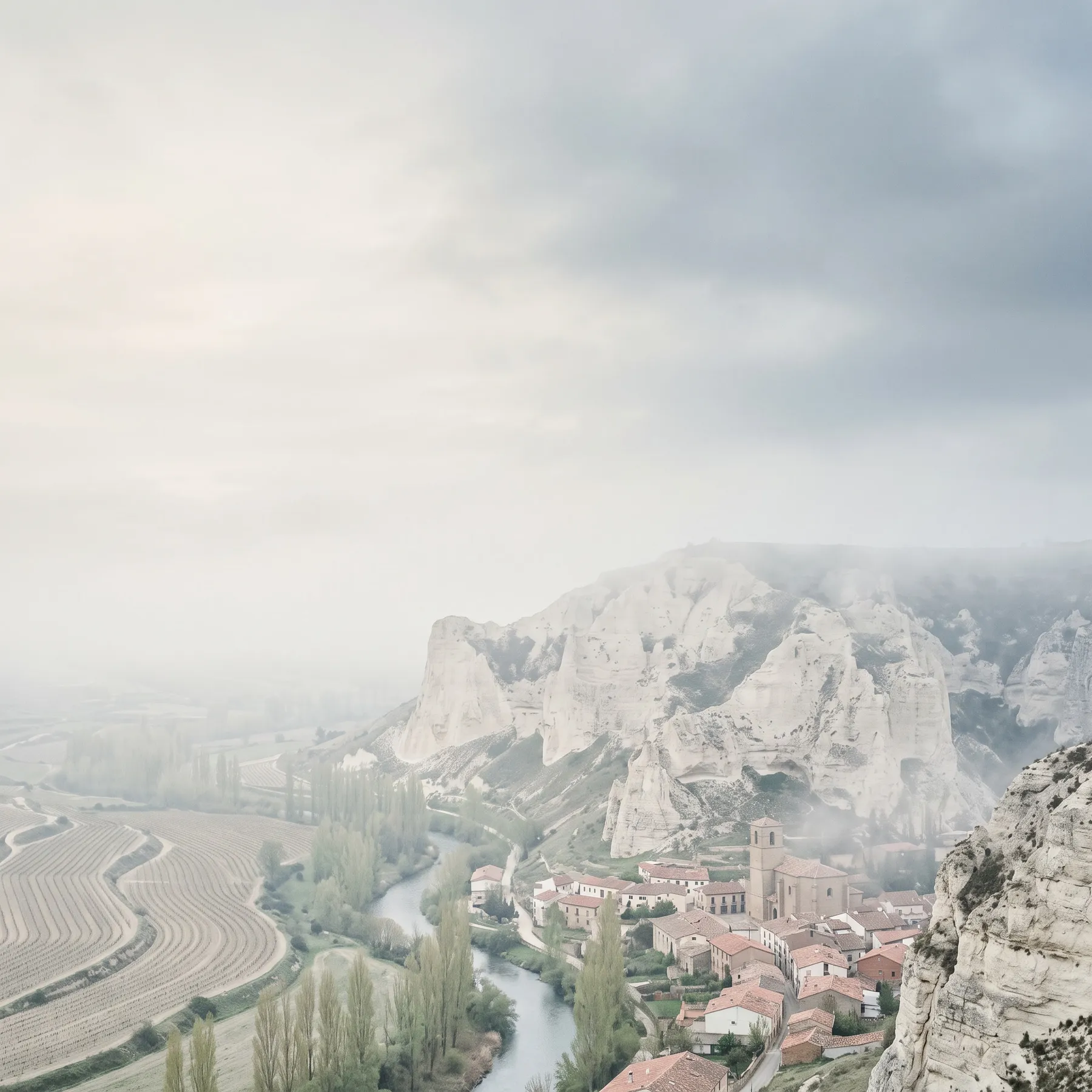
The name is older than the family. Albelda comes from the Arabic البيضاء al-bayḍā' — “the white.” It is the standard derivation for Albelda de Iregua, a village in the Iregua valley of La Rioja, a short way south of Logroño, where pale cliffs rise above the river.
In Spanish, b and v are spoken almost alike, which is how Albelda and Alvelda came to be written for the same name.
TRADITIONThe Battle Below the Cliffs
According to the Chronicle of Alfonso III, Musa ibn Musa of the Banu Qasi was building a great fortress at Albelda. His own people called him “the third king of Spain.” King Ordoño I of Asturias, with his ally García Íñiguez of Pamplona, laid siege to it. Musa camped on nearby Monte Laturce to break the siege. Ordoño split his army, beat Musa on the mountain, and took the fortress on the seventh day. The battle is dated to 859 or 860.
Legend: a story first written down in the 13th century places a battle at nearby Clavijo in 844, where Saint James, “Santiago Matamoros,” appears on a white horse. Historians treat Clavijo as legend. It may have grown out of the real victory at Albelda.
DOCUMENTEDA House of Books
King Sancho Garcés I of Pamplona and Queen Toda founded the monastery of San Martín de Albelda after they took Nájera and Viguera in 923. For the next century it was the cultural and intellectual centre of the Kingdom of Pamplona, and its scriptorium was one of the best in Christian Iberia.
DOCUMENTEDThe First Numerals
At Albelda the monk Vigila, his companion Serracino and his pupil García finished the Codex Vigilanus, also called the Codex Albeldensis, in 976. It gathers Visigothic law, church councils, chronicles and a calendar, and it is illuminated in the Mozarabic style.
One of its pages shows the numerals 1 to 9, without a zero. This is among the earliest known appearances of Hindu-Arabic numerals in Western Europe. The codex is now in the Real Biblioteca of El Escorial (shelfmark d.I.2).
DOCUMENTEDThe Age That Carried the Name
In August 1237 the forces of James I of Aragon, led by Bernat Guillem I d'Entença, defeated Zayyan ibn Mardanish of the Taifa of Valencia at El Puig. Valencia surrendered the next year. Around 1400 the battle was painted for the great Altarpiece of St George of the Centenar de la Ploma, by Andreu Marçal de Sax and Miquel Alcanyís. The altarpiece is now at the V&A in London.
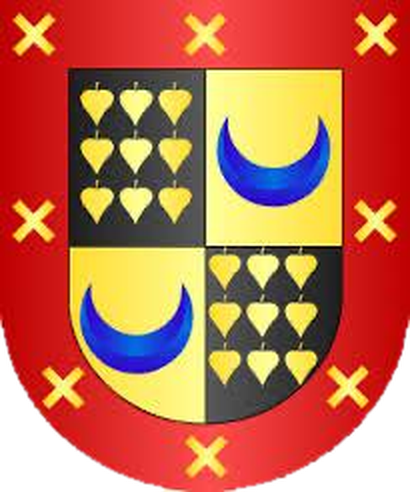
Nothing links the Alvelda line to El Puig directly. It stands here as the world the name came from: Christian and Andalusi, Latin and Arabic, the source of both the family's surname and its arms.
DOCUMENTEDAcross the Water
Over the centuries the name spread out from La Rioja. In this family's own research it appears in Argentina in the early 1800s, with Marcelino Alvelda (also written Albelda) and Simona Cejas in the Cuyo region of San Luis and Mendoza. The Alvelda and Albelda names appear dozens of times in the Catholic church registers of Mendoza, 1665–1975 (indexed on Ancestry).
Nobody yet knows how or when the name crossed from Spain. That paternal line is still an open research question. What the records do show is a family on the move: from the white cliffs of the Iregua, to the wine country below the Andes, and eventually to the United States, where the Alvelda name continues today.
FAMILY RECORDS · OPENSources
- Battle of Monte Laturce (second Battle of Albelda), 859/860
- Battle of Clavijo: legendary, first attested 13th c.
- Monasterio de San Martín de Albelda: founded by Sancho Garcés I and Toda
- Codex Vigilanus / Albeldensis: El Escorial d.I.2, early Arabic numerals
- Battle of the Puig, August 1237
- Altarpiece of St George (Centenar de la Ploma), V&A
- Albelda de Iregua, La Rioja
- Marcelino Alvelda × Simona Cejas: project research log (SOURCES.md)
On certainty
DOCUMENTED: from chronicles, charters or standard scholarship. TRADITION: the accepted derivation. LEGEND: an old story that is not history. FAMILY RECORDS · OPEN: from this project's own research, with unresolved questions.