
O’Donnell
and a road to Donegal not yet proven
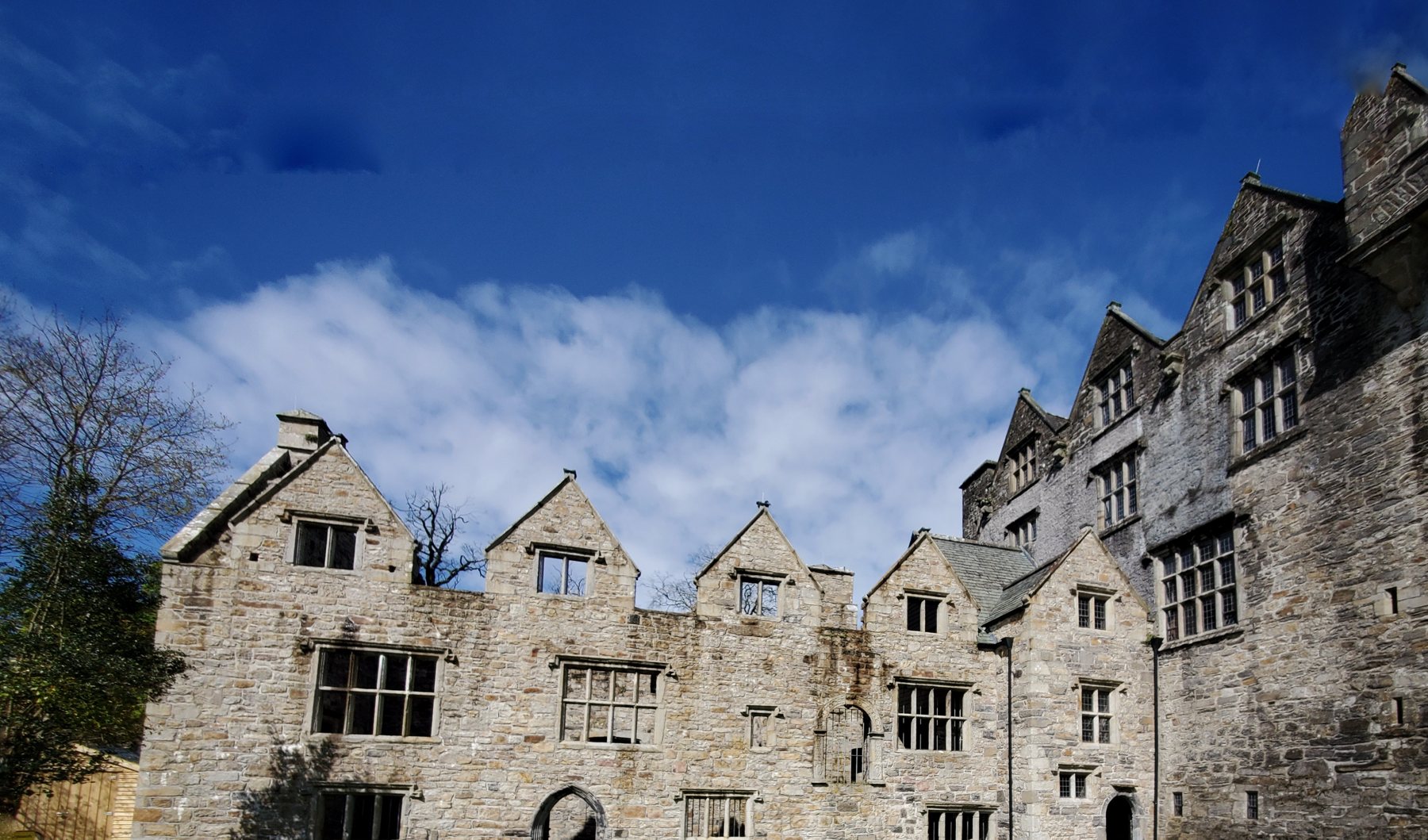

The line in the recordFrom Buenos Aires back to Uruguay
- Generation 1Phillip Alvelda Documented
- Generation 2Elsa Haydée Joseph O’Donnell Tree-recordedPhillip’s mother.
- Generation 3Alejandro Enrique Joseph Tree-recordedSon of Alejandro Joseph and Petrona O’Donnell.
- Generation 4Petrona O’Donnell × Alejandro Joseph DocumentedThe 1901 marriage register (Parroquia de San Cristóbal, Buenos Aires, entry 276) names her as born in Uruguay, a widow, and the legitimate daughter of Severo O’Donnell and Petrona Fernández.
- Generation 5Severo O’Donnell × Petrona Fernández DocumentedBoth are named in the 1901 register as natives of Uruguay (“R. Oriental”). The 1869 Argentine census finds Severo in Rosario, aged 30. This is the earliest O’Donnell we can document.
- Generation 6Severo’s parents GapThe search in Uruguayan parish records (Montevideo, c. 1836–41) is open. This is where the documented line stops.
Toward IrelandWhat is known, and what is only hoped
A separate O’Donnell family is well built in the FamilySearch tree. Carlos Santiago O’Donell Figueroa, born about 1781 in La Coruña, Galicia, reached Buenos Aires in 1802. His father is remembered only as Carlos O’Donell, “el irlandés”, born in “Irlanda”, with no county, parish or parents recorded. The trail dies there. Tree-recorded
No record yet joins Severo O’Donnell to that Galician-Argentine family. Earlier work in this project tried to bridge the two, and the bridge remains open. Under investigation
A link to the noble O’Donnells of Tír Conaill (Donegal), the lords of Tyrconnell whose exiled branches served Spain, would be further still. The surname alone is not evidence. O’Donnell is among the commonest Ulster names, and every O’Donnell family ultimately claims Tír Conaill as its homeland. Noble descent: hypothesis
ArmsThe arms of the O’Donnells of Tír Conaill

Arms of the name O’Donnell (Tyrconnell), as recorded in Burke’s General Armory, 1884. Modern AI-assisted rendering after MostEpic’s drawing, Wikimedia Commons; licensed CC BY-SA 4.0.
The arms of the sept, not a grant to our line
Or, issuing from the sinister side of the shield an arm fessways vested azure cuffed argent, holding in the hand proper a cross crosslet fitchée gules.
Recorded 1567 These arms were recorded in 1567 for Sir Hugh O’Donnell, Lord of Tirconnell, when he submitted to the Lord Deputy, Sir Henry Sidney, and was knighted. They are the oldest recorded O’Donnell arms, as given in Burke, The General Armory (1884), s.v. O’Donnell. Rory O’Donnell, Earl of Tyrconnell (d. Rome 1608), later bore a variant on his tomb in San Pietro in Montorio: silver field, arm from the dexter, a passion cross, and the motto In hoc signo vinces.
Tradition By tradition, St Patrick marked the sign of the cross on the shield of Conall, son of Niall of the Nine Hostages, the sept’s founder. The Tripartite Life tells the story, and Burke repeats it.
Under investigation What this is not: a grant of arms to Phillip’s family. We show them as the arms of the O’Donnell sept and its homeland. Our own descent from the Tír Conaill line is not documented.
Shield drawn for this site directly from the 1567 blazon, not copied from any modern rendering, then painted (NBP2) with that drawing as the exact reference and checked element by element against the blazon.
Arms · Elsa’s branchThe arms kept in the family
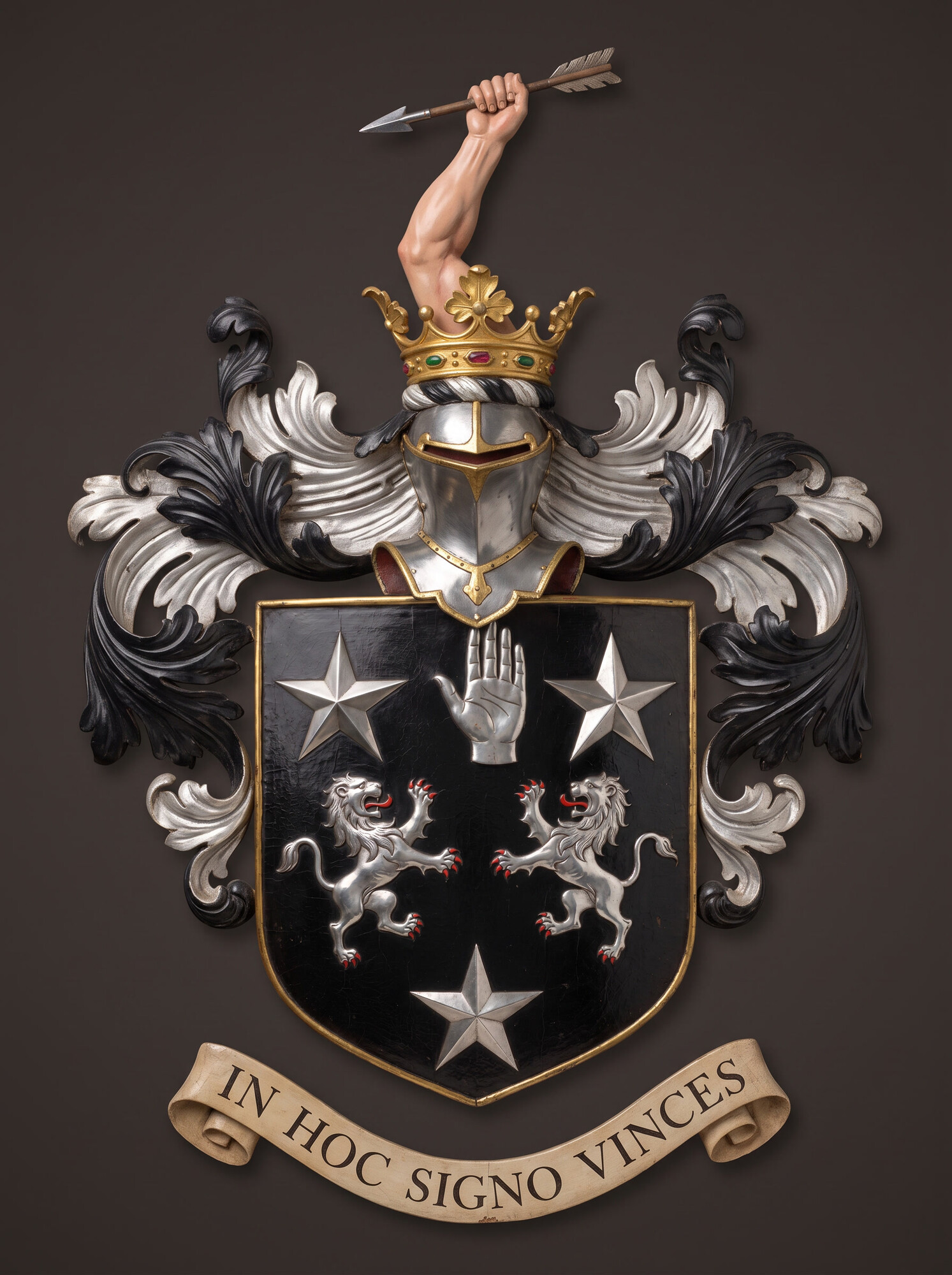
Arms handed down in the family
These are the arms that Elsa Haydée Joseph O’Donnell kept as those of her own branch of the O’Donnells. They are not the Tír Conaill arms shown above. The shield and the crest are different; only the motto is shared.
Sable, two lions rampant combatant argent, armed and langued gules; in chief a dexter hand couped erect between two mullets, and in base another mullet, all argent.
In plain English: a black shield with two silver lions standing on their hind legs and facing each other, their claws and tongues red. Across the top, a silver right hand cut off at the wrist, held upright with the palm showing, between two silver five-pointed stars. A third silver star sits below the lions.
Crest: out of a gold ducal coronet, a bare arm bent at the elbow, grasping a dart, in its natural colours.
Motto: In hoc signo vinces, “In this sign you will conquer.”
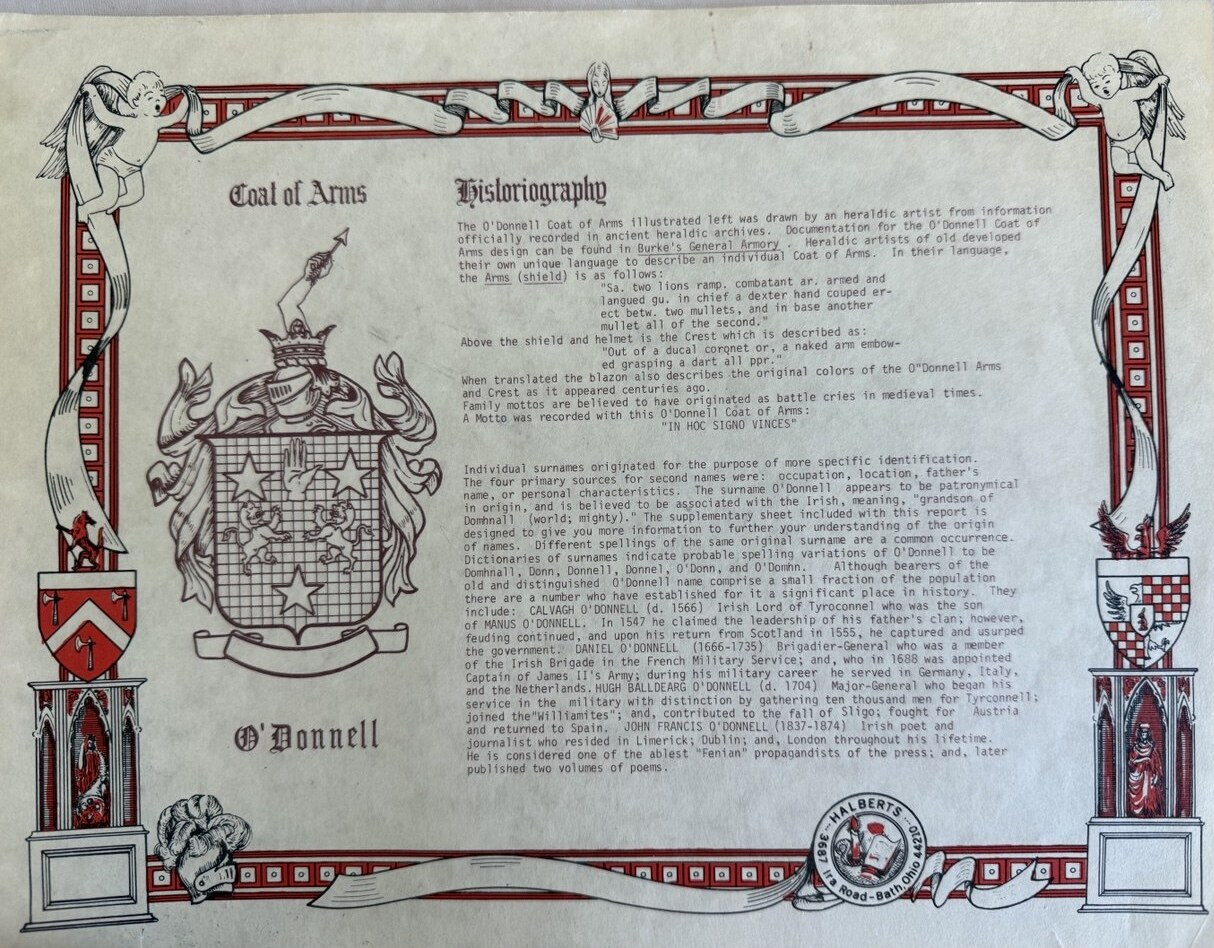
Documented · family Source. A Halbert’s (Bath, Ohio) “Coat of Arms” certificate for O’Donnell, kept by Elsa. It gives the blazon, the crest and the motto, and cites Burke’s General Armory.
Recorded 1772 Burke’s entry reads, word for word as on the certificate: “Sa. two lions ramp. combatant ar. armed and langued gu. in chief a dexter hand couped erect betw. two mullets, and in base another mullet all of the second. Crest—Out of a ducal coronet or, a naked arm embowed grasping a dart all ppr. Motto—In hoc signo vinces.” Burke gives these arms as allowed in 1772 by Hawkins, Ulster King of Arms, to James Brand O’Donnell, son of Richard O’Donnell and Alice Taylor of Swords, co. Dublin, “descended from Hugh O’Donnell, second son of Roderick O’Donnell, 1603”; and in 1777 the same arms, crest and motto to John O’Donnell, lieutenant-general in the service of the Emperor. Burke, The General Armory (1884), p. 748, s.v. O’Donnell.
Under investigation How Elsa’s branch joins those O’Donnells is not yet documented.
Painted for this site with Nano Banana 2 from the blazon and checked element by element: three stars, a right hand couped and upright, two lions facing each other with red claws and tongues, a gold ducal coronet, an arm bent at the elbow, a dart.